


Today, Nokia announced its forthcoming S60 touch UI. It’s awesome, impressive &… iphonesque! It’s a bit too early to compare it to another well-known, uber-publicized & generally-hated multi-touch phone, since it was only a software demo, not a hardware demo… But we can trust Nokia to come up with a jack-of-all-trades that will blow up the competition (like the N95-8GB)!

In Brief: -
- Efficient and intuitive touch UI with haptics tactile feedback. In other words, the touchscreen allows the user to feel the virtual keys. So you can type or press keys without looking at the screen!
- Support for both fingers and a stylus. (I hope they will replicate the iPhone’s keyboard - with haptics feedback - then it would be even better than a real keyboard!)
- Full support for existing S60 3rd Edition apps! (of course, these apps can be enhanced to take advantage of the new touch UI)
- Motion-based "flip to silence" mode, where incoming calls can be quieted by flipping the phone on its face! (see the video!)
- Support for kinetic, proximity, orientation and light sensors. (Ha-ha! the Accelerometer!)
- UI Accelerator Toolkit enables developers to make "impressive" graphical effects. (I can hardly imagine how much you’ll be able to modify the themes!)
- Flash video support on the S60 browser - now you’ll be able to watch YouTube & browse Flash sites!
- Available to S60 device manufacturers "during 2008."
Here's the video of S60’s touch UI - DON’T MISS IT (6.4 MB):
It seems that the video of the touch UI has been copied upon the phone ad. :-/ (Coz it’s obvious no device can have such a “time lag.”)
- Efficient and intuitive touch UI with haptics tactile feedback. In other words, the touchscreen allows the user to feel the virtual keys. So you can type or press keys without looking at the screen!
- Support for both fingers and a stylus. (I hope they will replicate the iPhone’s keyboard - with haptics feedback - then it would be even better than a real keyboard!)
- Full support for existing S60 3rd Edition apps! (of course, these apps can be enhanced to take advantage of the new touch UI)
- Motion-based "flip to silence" mode, where incoming calls can be quieted by flipping the phone on its face! (see the video!)
- Support for kinetic, proximity, orientation and light sensors. (Ha-ha! the Accelerometer!)
- UI Accelerator Toolkit enables developers to make "impressive" graphical effects. (I can hardly imagine how much you’ll be able to modify the themes!)
- Flash video support on the S60 browser - now you’ll be able to watch YouTube & browse Flash sites!
- Available to S60 device manufacturers "during 2008."
Here's the video of S60’s touch UI - DON’T MISS IT (6.4 MB):
It seems that the video of the touch UI has been copied upon the phone ad. :-/ (Coz it’s obvious no device can have such a “time lag.”)


Nokia Press Release - S60 smartphone software evolves to enrich the user experience
October 16, 2007
Expanding the platform with intuitive touch user interface, sensor technologies and complete web video experience
 Symbian Smartphone Show, London, UK - As Internet is entering into the core of mobile experiences, Nokia continues to implement new innovations for S60 on Symbian OS(TM), the market leading smartphone software, to develop the best possible mobile experiences for people.
 S60 will introduce new features that enhance the user experience and enable manufacturers, developers and operators to design new types of mobile devices, applications and services.
 The touch user interface in S60 smartphone software offers licensees the opportunity to develop devices with a variety of input methods, whether it is a touch screen with a traditional keypad, touch screen with a QWERTY keyboard or touch screen alone, supporting both finger & stylus optimized input, in addition to the range of access options that already exist today.
 S60 touch user interface comes with support for tactile feedback, which means that there is a physical pulse and feedback when the user taps on the screen. This provides better awareness of the device's response improving the user experience.
 Existing S60 3rd Edition applications will run on touch enabled devices unmodified. Tools will be made available for developers to further optimize the touch experience of their applications.
From motion and orientation to proximity and light, sensor technology is expanding to new areas and shaping the future for mobiles. S60 brings sensor support to the platform as a generic solution enabling support for a range of sensors in S60 devices. These technologies open up a new kinetic world to the user and offer completely new opportunities for application and game developers.
 Also, the new UI Accelerator toolkit will allow device manufacturers to develop rapidly and easily impressive graphical effects and new types of interactions, further increasing the user appeal and excitement.
 S60 will be the first mobile software platform to deliver the complete Web video experience as Flash Video will be integrated with the Web Browser for S60. This allows people to view on the go Flash-enabled Web sites and Flash Video, such as YouTube, as they would do on their desktops.
Want more?
Engadget - Nokia S60 Touch Interface Announced
AllAboutSymbian.com - S60 Touch Interface Launched
Nokia - Press Release
UPDATE: N95 8GB REVIEW!!!!!!


 There is only one cause behind global warming - emission of greenhouse gases by humans. All human activities directly & indirectly release greenhouse gases, the main source being combustion of fossil fuels and industrial processes.
 - Frequent droughts in Africa & Asia are leading to widespread famine since people can no longer farm on arid land.
  - Massive floods all around the world have caused property destruction, made millions homeless & hunger-stricken & triggered landslides.
  - Tropical cyclones & hurricanes have doubled in intensity each year, while other regions are no longer being affected.
  - Heat waves have become more frequent. Eleven of the twelve years in the period (1995-2006) rank among the top 12 warmest years in the instrumental record.
 - Average Arctic temperatures have increased at almost twice the global average rate in the past 100 years, contributing to a rise of the sea-level. Mountain glaciers and snow cover have declined on average in both hemispheres.
  - The worst affected have been the animal species. Unlike humans, they & their habitats cannot survive minor temperature changes. It is expected that 30% of all species will be extinct in 2050.
 - Polar ice reflects sun rays back in space better than the sea. But with the retreating ice, more sea water is exposed, contributing to further global warming and thus more ice melting.
  - Greater temperatures mean the oceans are becoming warmer, not only giving rise to further cyclones, but also killing coral polyps that cannot live in too warm waters. Polyps are essential in removing carbon dioxide from the atmosphere, by converting it into carbonates (corals). No more polyps & the carbon level will rise. In the same way, the oceans absorb a major amount of carbon emissions - however this has lead to the oceans becoming more acidic - leading to the death of polyps and planktons that use photosynthesis to convert carbon dioxide to oxygen. Planktons are also at the very bottom of the sea food chain.

 - Sea level will rise exponentially, since not only the polar ice is melting, but also warmer temperatures mean that the oceans have a greater expansion.
  - Although this is not certain to happen, global warming may disrupt the oceans thermohaline circulations, stopping the Gulf Stream & the North Atlantic drift. Any change in the circulation will stop the climate mechanism & we may end up with global cooling.
 - Renewable energy should be heavily promoted as it has zero carbon emissions & is quite cost-effective. Since photovoltaic cells are becoming cheaper & more efficient every year, if everyone could fit them on houses & buildings it might be more than enough to provide for the entire electricity consumption. Similarly wind turbines could serve for the same purpose. The surplus electricity would be fed into the electricity grid & the fossil fuels may disappear from power production, the remaining power coming from hydroelectric & biomass power plants.
 - Hybrid vehicles should be encouraged - with the long-term objective of fully-electric powered & hydrogen-powered vehicles.
 - Individuals can also help by building energy-efficient houses, using energy-efficient products, buying local produce, producing less waste, recycling the waste & by switching to a vegetarian diet.
  - Airplanes in a single flight emit as much carbon as a car does in a whole year. People should avoid using airplanes, & airplane manufacturers should research newer engines with minimal fuel consumption.
 Wilkinson, whose kicking has been below par in France, missed the tricky conversion, with the ball snaking left of the posts as it has done all too often for the England's fly-half's satisfaction all tournament.
 The hosts edged further ahead after 44 min through Beauxis' third penalty after England again infringed at a ruck but the visitors soon hit back through Wilkinson's boot.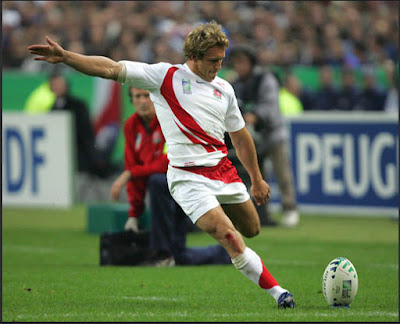
 Dan Hipkiss, on as a replacement for Lewsey after the Wasps man appeared to pull a hamstring, made a break to initiate a surging attack and when France fell offside Wilkinson landed his 50th World Cup penalty to make it 8-9. Jonny Wilkinson was back!
 After that it was an infinite period of phases & throws, with both teams coming within 5 m of a try but unfortunately they both made mistakes at the crucial moment.

 Both teams stepped up their plays, with England now occupying France’s territory. The English players were buying time by keeping the ball & by extending the phases. The inevitable had to happen. On the 78th min, Jonny Wilkinson lined up for a drop-goal & he struck gold again. The 30,000-strong England contingent went wild, courtesy of a man who again lived up to his reputation for never letting them down. England 14-9 France.

 It was a do-or-die situation for France. If they made a try, they would be level with England. The hosts threw everything at the champions in a series of desperate late attacks, but it was a little too late…
  ENGLAND ARE IN THE WORLD CUP FINAL!!!!
